

Can You Be Hypnotized to Get Over a Fear? 5 Powerful Truths
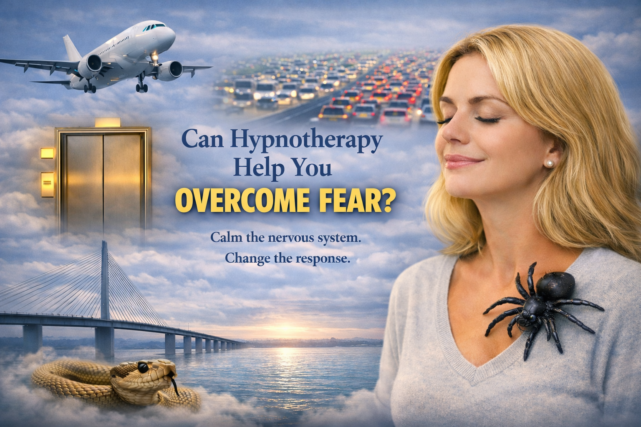
Can You Be Hypnotized to Get Over a Fear? 5 Powerful Truths
Can you be hypnotized to get over a fear? The short answer is yes, in many cases you can. But not because hypnosis is mind control.
As a Certified Clinical Hypnotherapist with more than 12 years of experience, I have worked with many people who felt trapped by fear. My honest answer is that success depends on the person, their willingness to participate, and what is truly driving the fear.
In my practice, I often help clients with fears involving flying, public speaking, driving, elevators, dogs, snakes, spiders, medical procedures, rejection, and emetophobia. What I have learned over the years is simple: fear is not always irrational. Sometimes it begins with a real experience and then grows into a pattern that the nervous system keeps replaying.
Can You Be Hypnotized to Get Over a Fear by Calming the Nervous System?
That is often where the change begins.
Hypnosis can help a client calm their nervous system, feel safer in their body, and become less reactive to situations that once triggered intense fear.
During hypnosis, a person is still aware and still in control. However, they are often more receptive to helpful suggestions, healthier emotional associations, and new ways of responding to situations.
It also helps to understand that fear, phobia, anxiety, and trauma responses are not the same thing.
- Fear is a normal response to danger happening now.
- A phobia is an intense fear reaction that is far stronger than the actual threat.
- Anxiety is more about anticipating something bad that might happen.
- Trauma-related responses often come from past overwhelming experiences that the nervous system still reacts to.
Sometimes a second layer develops where a person starts fearing the fear itself. They are not only afraid of flying, elevators, or spiders. They begin to fear the racing heart, panic, or loss of control they expect to feel. This can create a cycle where anticipating the fear becomes part of the problem.
Clinical research supports the idea that fear and phobias can be treated. The National Institute of Mental Health notes that specific phobias are common and more prevalent in women, and treatment often includes psychological approaches such as exposure therapy. Hypnosis is also listed as one potential approach for addressing phobic reactions.
Learn more here:
https://www.nimh.nih.gov/health/statistics/specific-phobia
Can You Be Hypnotized to Get Over a Fear If the Fear Feels Logical?
Yes. Many fears make perfect sense once you understand their origin.
One client came to me with a fear of heights, especially bridges, that began after the 1980 Sunshine Skyway Bridge disaster in Florida. Even decades later, driving over bridges triggered intense anxiety. Through hypnotherapy, we worked to shift his focus away from the tragedy and toward the present reality of safety. Over time, he was able to drive over bridges comfortably again.
Another client had such an intense fear of snakes that she barely left her house. She would send her children ahead of her to check the garage before walking outside. Even hearing movement in the bushes could send her into panic. After our sessions together, she was able to leave home calmly and confidently. Just as important, she felt proud to show her children that change is possible when you commit to it.
I also worked with a retired international race car driver who suddenly developed a fear of flying. During the pandemic, he was forced to leave his wife behind in the Dominican Republic while she recovered from COVID before being allowed to fly back to the United States. That experience created a powerful emotional association with flying. Through hypnotherapy we reset that fear response, and today he and his wife have returned to traveling the world together.
These are just a few examples from more than a decade of helping people create meaningful change through hypnotherapy.
Can You Be Hypnotized to Get Over a Fear According to Research?
The research surrounding hypnosis is encouraging, though it is important to present it honestly.
A 2019 meta-analysis found that hypnosis was more effective than control conditions for reducing anxiety symptoms, particularly when combined with other psychological treatments.
https://pubmed.ncbi.nlm.nih.gov/31251710
A 2022 systematic review examining hypnosis for dental anxiety and phobia found promising results, suggesting hypnosis can be a valuable option for reducing fear in certain situations.
https://pubmed.ncbi.nlm.nih.gov/35624907
A 2023 pilot randomized study investigating hypnotherapy for agoraphobia also showed meaningful improvements compared to a waitlist control group.
https://pubmed.ncbi.nlm.nih.gov/37637902
While more research is always valuable, these findings suggest hypnosis can play a meaningful role in helping people reduce fear and anxiety.
Can You Be Hypnotized to Get Over a Fear Permanently?
Sometimes the change happens quickly. Other times it takes a little longer.
The real goal is not to eliminate every moment of fear from life. The goal is to change the automatic reaction so that you can respond calmly and confidently instead of feeling controlled by the fear.
One of the things I love most about working one-on-one with clients is that I am not locked into a rigid method. My philosophy is that people already have the resources they need within them to create change. Hypnotherapy simply helps access those resources and strengthen healthier responses.
So, can you be hypnotized to get over a fear?
In many cases, yes.
If you can begin to imagine yourself living free from that fear and connect with the emotions that would come with that freedom, you have already taken an important first step.
If you are ready to explore that possibility further, the next step is to CLICK HERE to schedule a complimentary strategy session. During that conversation we can talk about how the fear has been affecting your life, how hypnotherapy may help, and whether we are a good fit to work together in a supportive, pressure-free environment.


